
By Rinki Pandey January 22, 2026
Payment processing for high-risk merchants is seldom easy or predictable. The industries of subscription services, travel, digital products, nutraceuticals, online coaching, gaming, and international eCommerce have their problems in banks and payment processing, besides the usual scrutiny. The different factors, like high chargeback rates, fraud exposure, cross-border transactions, or delayed fulfilment, are responsible for the industry being labelled “high risk”. Consequently, payment processors are introducing extra security to prevent losses—one of the common methods used is rolling reserves.
The rolling reserve is often misinterpreted by the high-risk vendors as a fine or a sign of trouble coming. In fact, it is a perfect risk-management tool that the payment processors and the acquiring banks use to protect themselves in case disputes, chargebacks, or refunds arise after the transactions are settled. Although rolling reserves can take away access to the full revenue of the transactions for a while, they allow the high-risk merchants to get and keep the card payment processing that would otherwise be denied completely.
This guide visualizes rolling reserves in a simple, hands-on, and business-centred approach. You will get to know the working of rolling reserves of the payment processor, the reason for the demand for rolling reserves by payment processors, and the impact of these reserves on the cash flow and financial planning for the long term.
However, the most important thing is that the guide suggests high-risk merchants verified ways to work on the reserve percentages reduction, holding period shortening, and better terms negotiation through their relationship with the processor in the long run. When accompanied by the right knowledge and customer service, rolling reserves can become a part of the business and not a fear factor, enabling the high-risk merchants to grow with confidence and stability.
What Rolling Reserves Mean for High-Risk Merchants
A rolling reserve is a practice adopted by payment processors in which a certain percentage of high-risk merchants’ transactions is withheld for a specific duration. The merchant does not get the entire amount due for the settlement immediately. They would rather participate in the reduced payout for the remaining portion being held as a buffer against any possible financial problems.
The funds that are held back are released in a rolling manner. For instance, if 10% of the transaction is set aside for 90 days, then, simultaneously, the funds that were withheld today are due for release after 90 days, while new transactions keep on going into the reserve. This puts the merchant in the position of having a continuous cycle rather than a one-time hold. The major features attached to rolling reserves for high-risk merchants are:
- A certain percentage is automatically taken from each deal.
- A specific holding period, which is usually 90–180 days.
- Funds are released automatically if no disputes arise.
Once the merchants get to know this framework, the high-risk merchant rolling reserve turns out to be much more predictable. The payment processors’ rolling reserves are aimed at risk management rather than blocking any rightful business from continuing to operate.
Also Read: How to Negotiate Lower Credit Card Processing Fees for Your Business
Why Payment Processors Require Rolling Reserves for High-Risk Merchants
Payment processors usually ask for rolling reserves due to the nature of high-risk merchants—data shows that they have a greater chance of causing financial losses. In the case of a customer disputing a transaction, the processor has to act fast and return the money to the customer—this will be the case even if the seller is unable or unwilling to return the money. Several things increase perceived risk and thus lead to the requirement of rolling reserves:
- High chargeback or refund ratios.
- Subscription or recurring billing models.
- Long delivery or business timelines.
- Cross-border or multi-currency transaction.
- Limited processing history or new businesses.
From the point of view of the processor, rolling reserves provide liquidity that can be used to cover potential losses. It is this reason that payment processors’ demand for rolling reserves becomes a point of control for high-risk merchants who can thus bring their operations in line with processor expectations and prevent friction from arising between them.
How Rolling Reserves Are Structured for High-Risk Merchants
The rolling reserves for high-risk merchants are developed depending on a comprehensive risk assessment. The merchant accounts are not the same, and thus, the reserve conditions are tailored to the individual companies. Typically, the most common rolling reserve practices are as follows:
- Reserves that are percentage-based and range from 5% to 15%.
- Periods of release based on time that are 90, 120, or 180 days.
- Caps that are either monthly or based on volume to limit the total size of the reserve.
Moreover, processors might synchronize rolling reserves with other risk management measures, such as placing limits on the number of transactions or intensifying monitoring. It is crucial to have proper documentation and be transparent since the payment processor rolling reserves have a direct impact on the daily settlement amounts.
The Impact of Rolling Reserves on High-Risk Merchants’ Cash Flow
Rolling reserves for high-risk merchants are mainly a cash flow issue and not a profitability issue. The funds that are withheld lower the immediate access to the revenue. If not planned, it may cause a strain on cash flow. The cash flow difficulties most often encountered are:
- Working capital for marketing and growth is reduced.
- Access to earned revenue is delayed.
- There is an increased dependence on external funding.
Nevertheless, high-risk merchant rolling reserves are a predictable process in the long run. Merchants that are considered high-risk and schedule their settlements with reserve deductions can keep the situation stable and not have to go through any interruptions in their operations.
High-Risk Merchants and Chargebacks: The Core Reason Behind Rolling Reserves
The need for rolling reserves for high-risk merchants is mainly due to chargebacks. The card networks impose financial penalties and monitoring programs on processors if a customer disputes a transaction. Chargebacks usually result from:
- Billing descriptors that are not clear at all.
- Refund or cancellation processes that are poor.
- Customers are dissatisfied or have their expectations not met.
- Fraud or transactions not authorized.
Since chargebacks signify a financial loss, payment processors ask for rolling reserves to cover their risks. Reducing chargebacks is the quickest and most efficient method for high-risk merchants to get better processing terms.
Types of Rolling Reserves Used for High-Risk Merchants
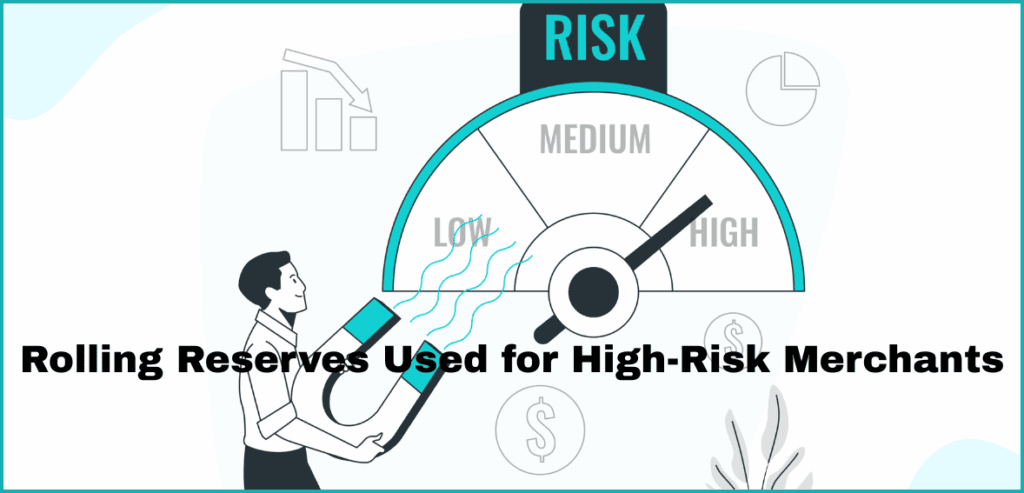
Processors prioritize their reserve models according to the risk involved with the merchant. High-risk traders must be aware of the differences before the processing contract is signed. The reserve types that are most frequently used include:
- Rolling reserves, where the cash is held back and then released gradually.
- Fixed reserves when a certain amount is blocked from the start.
- Capped rolling reserves, where the release is stopped when a certain level is reached.
Rolling reserves are usually the first choice since the money is always released, and eventually, the liquidity gets better in the long term. The rolling reserves of the payment processor are likely to be modified as the risk decreases.
How Long Rolling Reserves Last for High-Risk Merchants
The high-risk merchant’s duration of rolling reserves varies with his performance and risk behavior. Generally, the holding periods are from 90 to 180 days. The processors determine the duration by the following factors:
- Consistency of transaction volume
- Chargeback and refund rates
- A business’s life and stability
Rolling reserves, however, are not good by default. A lot of high-risk merchants with steady performance eventually get their reserve times shortened or their percentages lowered.
Can High-Risk Merchants Reduce or Remove Rolling Reserves?
In many cases, high-risk merchants can obtain the reduction or removal of rolling reserves by showing their risk as lower. Issuers are constantly reassessing the accounts and making the necessary adjustments to the terms. Some of the effective strategies are:
- Keeping chargeback ratios less than the network thresholds.
- Making customer service and dispute resolution better.
- Providing clear refund and cancellation policies.
- Demonstrating consistent processing volume over a period.
High-risk business capital for merchants who tackle the sources of the risks not only improves their negotiating leverage but also reduces the downtime of the transactions.
Negotiating Rolling Reserves as a High-Risk Merchant
It is possible to negotiate, even in the risky categories. Most merchants in high-risk areas that do not renegotiate their contracts take it as a fixed reserve term as a reason to stay silent. When a merchant is discussing with the payment processor, the focus should be on the following areas:
- A decrease in reserve percentage.
- A little while shorter periods of holding.
- A clear definition of reserve limits.
Presenting supporting data such as financial statements, fraud prevention tools, and customer metrics will enhance credibility. Understanding the reasons for rolling reserves by payment processors will assist merchants in providing evidence to counter concerns.
Choosing the Right Processor for High-Risk Merchants and Rolling Reserves
High-risk merchants are not treated in the same manner by all processors. Specialized high-risk processors recognize the risks associated with particular industries and allocate reserves more equitably. Among the main characteristics that the processors must possess are:
- Terms of the reserve that are transparent.
- Reviews of performance are carried out at regular intervals.
- Support for both the account and the risk that is dedicated.
- Channels of communication that are clear.
The operational burden brought about by payment processor rolling reserves can be considerably reduced by selecting the most appropriate processor.
Common Myths About Rolling Reserves for High-Risk Merchants
A great deal of the time, high-risk merchants have wrong notions regarding rolling reserves stemming from little transparency or negative experiences in the past. These misunderstandings frequently lead to bad decisions. Several myths are still very much alive in high-risk industries:
- Permanent rolling reserves. In fact, the reserves are regularly assessed and modified according to performance.
- Reserves signify the failure of the business. Rolling reserves are a representation of risk exposure, not the quality or success of the business.
- The same terms apply to all processors. The rolling reserves of payment processors vary a lot depending on the provider and the market.
By dispelling these myths, high-risk merchants can choose the reserves option, which is the least emotional and most rational.
Best Practices for Managing Rolling Reserves for High-Risk Merchants
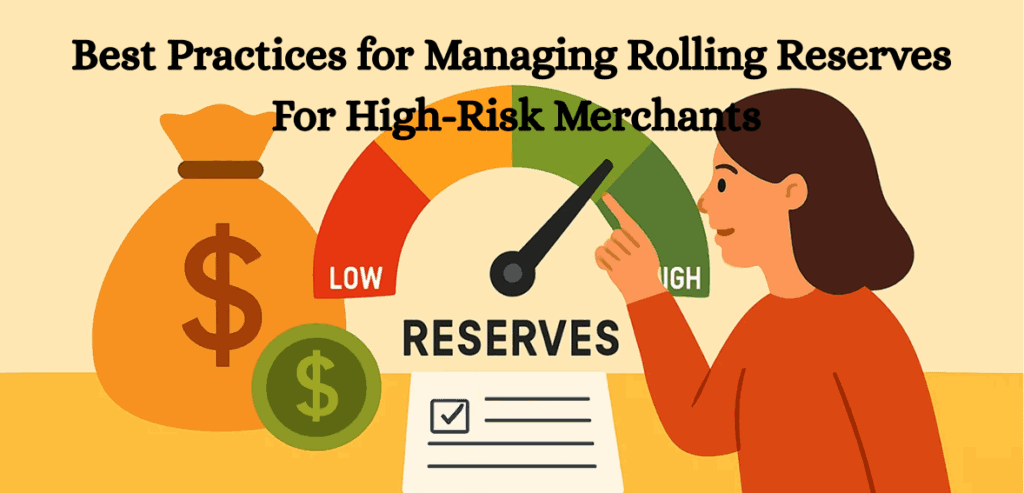
Merchants designated as high-risk but successful have a different view of rolling reserves as they consider them as usual operational expenses rather than barriers. By taking a proactive approach, they make reserves calculable and controllable. The recommended practices are:
- Regularly checking reserve balances.
- Estimating cash flow with reserve deductions.
- Being involved in chargebacks and refunds.
- Keeping the lines of communication open with processors.
Through careful planning, rolling reserves are transformed into a manageable part of the payment processing.
Conclusion
Rolling reserves are the way to go for merchants dealing with high risks, but that does not mean they cannot grow or have long-term success. When rolling reserves are correctly interpreted, they function as a flight security that gives the confidence to payment processors to support businesses in that risky environment. High-risk dealers, instead of regarding reserves as a hurdle, should consider them as one of the elements of the cost of having access to a trustworthy card payment infrastructure.
High-risk merchants can improve their processing terms gradually by understanding the workings of the payment processor’s rolling reserves. Identifying the reasons for the payment processor’s requirement of rolling reserves, and actively taking steps to minimize chargeback risk. Good communication with customers, fair billing practices, and regular transaction performance are some of the factors that reduce the risk perception.
Rolling reserves are never signs of business failures or instabilities. They, on the contrary, are signs of opportunities for operational strengthening, processor trust-building, and long-term reliability proving. Through the right processor, disciplined financial planning, and continuous risk management, high-risk merchants can bring down the reserve requirements and develop over time sustainable and profitable payment relations.
FAQs
What does a rolling reserve mean in the context of high-risk merchants?
With high-risk merchants, a rolling reserve means that the processor has blocked a part of each transaction for an agreed period as a cushion against potential chargebacks or refunds that may occur in the future.
What are the reasons for payment processors to ask for rolling reserves in case of high-risk merchants?
Payment processors need rolling reserves because the high-risk Merchants are likely to be involved in financial disputes through chargeback, fraud, and the like, very often, or their delivery of products may take longer than expected.
How much of a payment processor’s rolling reserves is usually kept?
Payment processors’ rolling reserves generally keep a portion of 5% to 15% from every transaction according to the risk level and processing history.
Is it possible for high-risk merchants to lessen or do away with a rolling reserve situation?
High-risk merchants have the option to reduce or completely do away with rolling reserves by actively managing their transaction volumes to low chargebacks and consistently maintaining good transaction performance.
What is the period of holding rolling reserves for high-risk merchants?
High-risk traders are commonly subjected to rolling reserves that span between a discharge period of 90-180 days.